Twenty-two four. Forty pieces. The buyer at an aerospace tier-two in Connecticut read my number back to me over the phone last March, then told me the low bid was twelve six.
He asked if I wanted to sharpen my pencil.
There’s a thing in this trade that never shows up in the metal. Cost has almost nothing to do with how much material comes off. Two parts can pull the same volume of chips out of the same block and land 3x apart, because one runs in one setup and the other runs in three.
Every setup is a re-fixture. A re-touch-off. A first article. One more chance to lose your datum.
And underneath all of it, work-holding. How you actually grab the thing while you cut it.
15-5 PH housings. I planned them the way I plan every job I quote, op by op, before the number goes out.
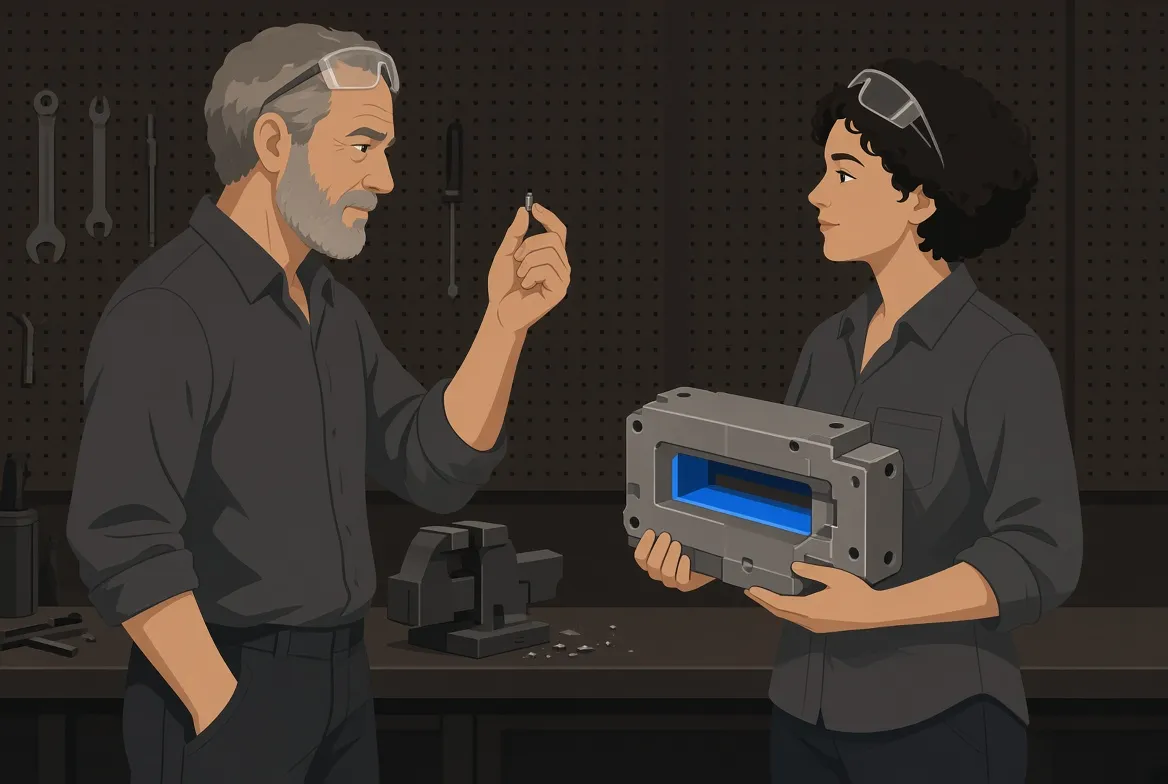
Op three had nowhere to grab. Every surface worth clamping on was finished by then. So you build a plate with locating pins and soft jaws cut to the contour, or you fight it one part at a time and hope.
Nine hours of design and proving. Call it four thousand with the stock and the test cut.
It’s in my twenty-two four. It’s a line. I can show you where.
I didn’t sharpen the pencil. We didn’t get the job. My number was right and I’d send the same one tomorrow.
Five months later the drawing came back to me. Requote, balance of twenty-six pieces.
I asked the buyer what happened over there. He didn’t answer. He forwarded me a change order the other shop had filed against the PO.
Non-recurring tooling. One fixture. Nine thousand one hundred.
Dated seven weeks after the purchase order.
Seven weeks.
They didn’t find op three when they priced it. They found it at the machine, with the material already bought and the date already promised.
The spread between my number and theirs was nine thousand eight hundred. The fixture came back at nine thousand one hundred.
The thing that was missing from their price was the thing that had to exist.
I don’t think anybody over there was careless. That number came out of an estimate, and estimating is honest work. Stock envelope minus finished volume. A removal rate. Minutes per hole. An allowance for setup, one for programming, one for inspection. It’s calibrated on real history and across three hundred parts it lands close.
You’re not buying three hundred parts. You’re buying one.
A price is not a plan.
For as long as there have been job shops, a quote has mostly been a comparison. Somebody looks at your part, thinks about the parts that looked like it, and prices the resemblance. It’s fast, it’s usually not crazy, and nobody can check it. Not the buyer. Not the estimator who wrote it.
A plan can be checked. Ordered ops. How many setups. How it’s held in each one. Which tools, and which ones we don’t own yet. What it costs to build the fixture that doesn’t exist. The price falls out of that at the end, as arithmetic.
Both things arrive in your inbox looking identical. A number, in a nice font, under a logo.
The question was never which shop is cheapest.
It’s which one already knows how your part gets held.