I spent two days last September in Chicago standing in front of robot cells.
A six-axis arm tending two mills. A stacker pulling blanks off a pallet. Somebody’s shop on video, running dark from ten at night until six.
I stood at one long enough that the guy working the booth started filling out paperwork.
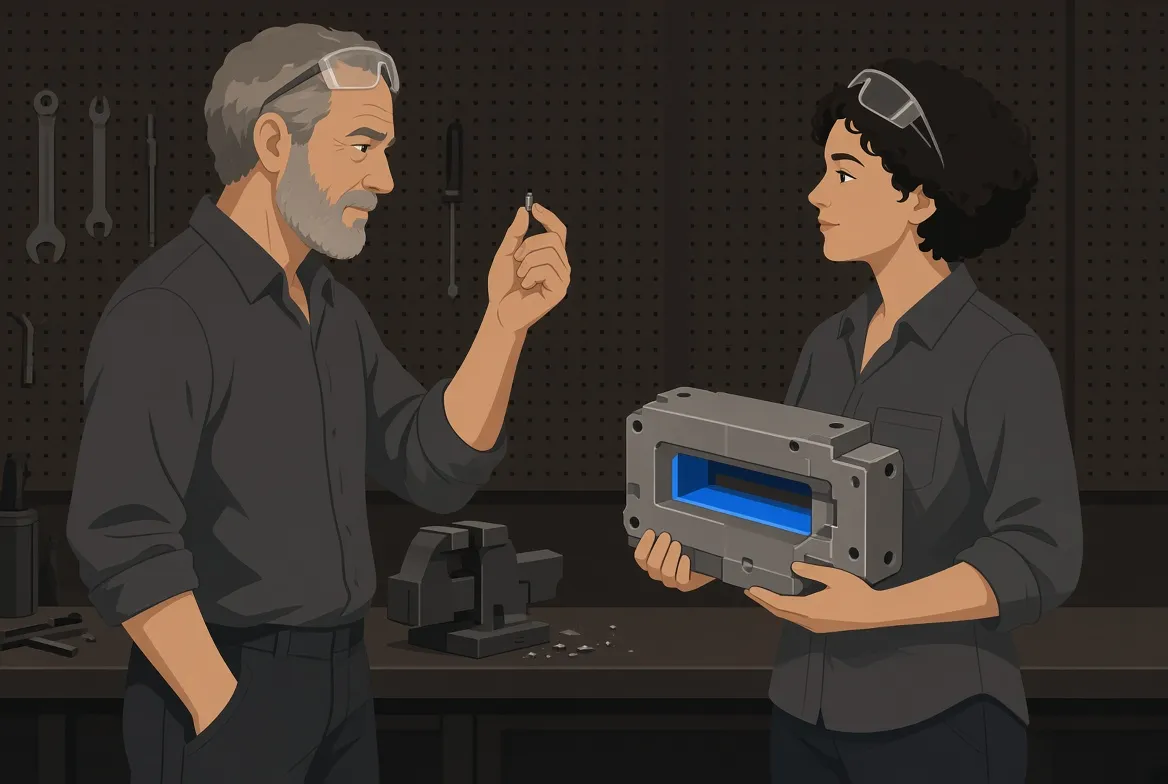
Something about a shop my size never makes it into a brochure. Our spindles don’t sit still because nobody’s there to load them. They sit still in gaps of nine and eleven minutes. Between setups. Waiting on a fixture, or a first article.
A robot doesn’t buy those minutes back. A robot buys back the third shift you weren’t running.
I knew that standing there. I priced the cell anyway. A hundred and eighty thousand, installed.
Thursday I flew home. I came through our office around 6:40 that evening and our office manager was still at her desk.
Customer purchase order open on one monitor. Our business system on the other.
Part number. Revision. Quantity. Due date. Unit price. Ship-to.
Every one of those facts already existed. Somebody at the customer typed them once. Their software turned them into a PDF. Now a person I pay well was typing them a second time, because that’s the only way our system was going to learn the order happened.
She’s good at it, and she’s never put a wrong revision into that system. If she had, we’d have cut metal to it.
I asked how much of her week that is. Four hours, she said. Five if it’s a Monday.
I let that sit a week, then I asked everybody else. Not what their job is. What they retype. Where a fact we already have gets keyed in by hand a second time.
Quoting. Purchasing. Scheduling. Certs. Inspection results written on paper, then typed, then put in an email.
Fifty-one hours a week.
The cell in Chicago would have given back about six hours of spindle time a week.
Fifty-one hours.
Then I did the thing that changed my mind. The show guide was still in my bag. I went through it booth by booth. All hundred and forty.
Every one of them selling a way to make the cutting better.
Not one selling anything for the room where the hours were. I hadn’t been looking in the wrong place at that show. The show didn’t have the place.
The hours were in the office.
One thing I want to be exact about, because it’s the first question I’d ask. All of this runs on our own servers, in our building, on open-source models. Nothing goes to ChatGPT or Claude or anyone else’s API, and none of it trains anybody’s model. Geometry, part numbers, pricing. It stays on hardware we own. I’d like to say I chose that on principle. Our aerospace, medical device and semiconductor customers asked in writing before we’d built anything, and one made it a condition of sending us work. That settled it in a day.
Quotes go back inside 24 hours now. Purchase orders land in our system without anyone typing them.
Nobody left. Headcount’s flat and I don’t expect it to drop. Our office manager spends those hours chasing certs and talking to customers, which is what I hired her for. Same people, work worth their time.
What I don’t know is whether that holds at twice my size, or flips back to the floor past it. I’m confident about the first fifty-one hours. Not the next fifty.
For a hundred years the way you made a shop better was to make the cutting better. Higher speeds. Carbide. CNC. Pallet changers. All real. I’d buy them all again.
The office got a fax machine, then email, then nothing.
Every owner I know can tell me their spindle utilization to the point.
I’ve never met one who can tell me the other number.