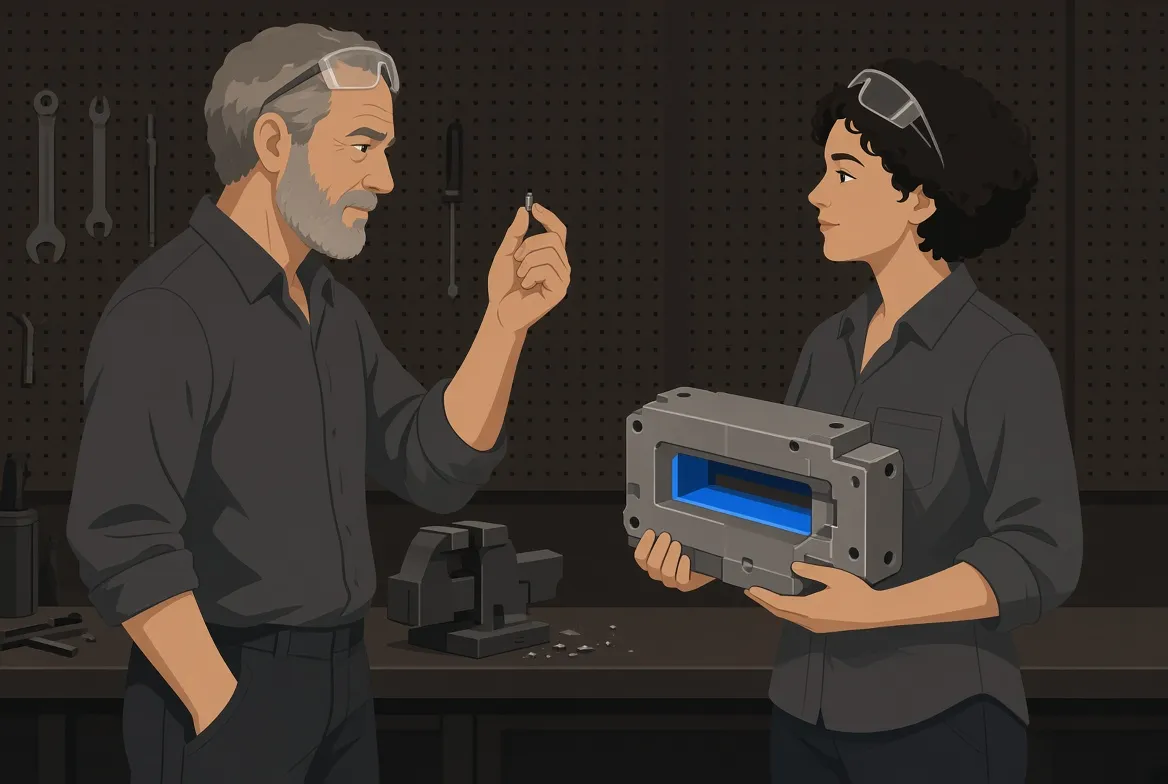
Our senior machinist looked at the setup for about five seconds, told the machinist running the job to run the feed up instead of down, and went to lunch.
He knows this setup from years of running it.
There’s a thing about the 316 we run. It work-hardens. When it starts to squeal, your hands want to back the feed off, and backing off is what kills the part. You rub it, it hardens under the tool, and then nothing you put in the spindle will cut it.
You have to push in.
That isn’t on any setup sheet. It’s in our senior machinist.
He knows other things. He knows the fixture on the second shelf in the tool room fits that whole bracket family. Somebody built it in 2021 for a job that’s long gone. It saves an hour and a half of setup every time the family comes back around.
In April he was out four days.
Same bracket came through.
The machinist running the job is good. He built soft jaws from scratch, got the clamping right, ran the lot, and it shipped on the date we promised. Took him a little over two hours to arrive at the place our senior machinist starts from.
Nobody did anything wrong. We just bought that fixture a second time.
That’s the small version.
In May a housing came back that we’d last run in 2021. Thin wall, 17-4, and it moves. Rough it the obvious way and it comes off the machine out of round by more than the print allows.
Three of us got into it. The estimator, the programmer, the man on the machine. We changed the order of operations. Roughed both sides before finishing either one. Let the part sit overnight between ops.
It came out. All eighteen, in spec, on the promise date. I’d run it the same way again tomorrow.
A day and a half to get there.
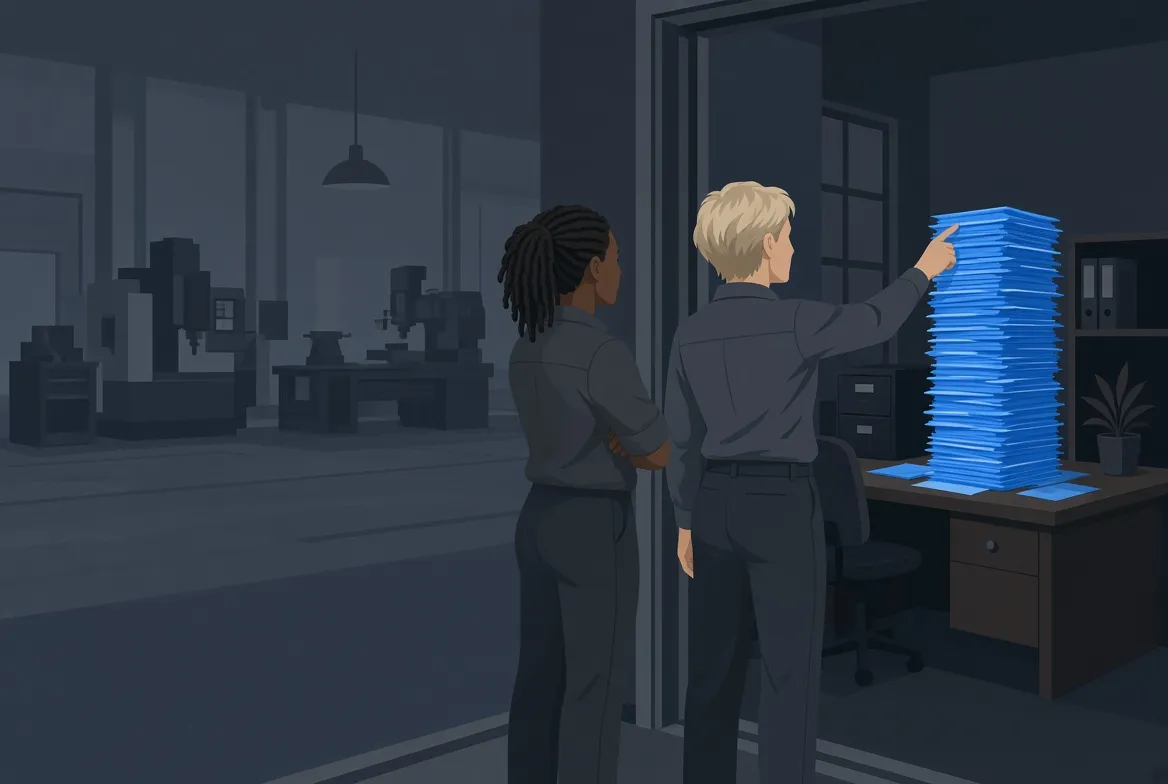
Two weeks after that I was in the folders hunting for an inspection report and opened the 2021 job by accident. There was a note typed at the bottom of the old setup sheet, after the run. Rough both sides, let it rest, finish the second op in the morning.
Nineteen words.
Nineteen words, sitting in this building for four years, while three people who are good at their jobs worked the same answer out from the beginning.
Both times we solved it. We paid for it twice.
The second time you make a part should cost less than the first. That only happens if the second time can find the first.
So we’re trying to make the job carry what it taught us instead of the people carrying it. Run times off the machine, not off a form. Inspection out as data. The fixture photographed and tied to the part instead of to a shelf.
It slips. Last week of the month, when we’re buried, the photo doesn’t always get taken, and I know that because I go looking and sometimes it isn’t there. We’re better at this than a year ago and we’re not finished.
We do use AI to surface prior work that resembles a new request. It runs on our own servers, here, on open-source models. Your drawings never go to an outside AI provider and nothing you send us trains anybody’s model. Your history informs your parts and nobody else’s.
For most of the history of this trade, a shop’s memory was people. You learned by standing next to someone over years, and the folders got filed by number and went quiet the day the job shipped. Nobody goes hunting through 2021. You find the fixture because our senior machinist tells you where it is.
Which works until a Tuesday.
The question isn’t whether your shop knows how to make your part.
It’s whether the answer is a name.