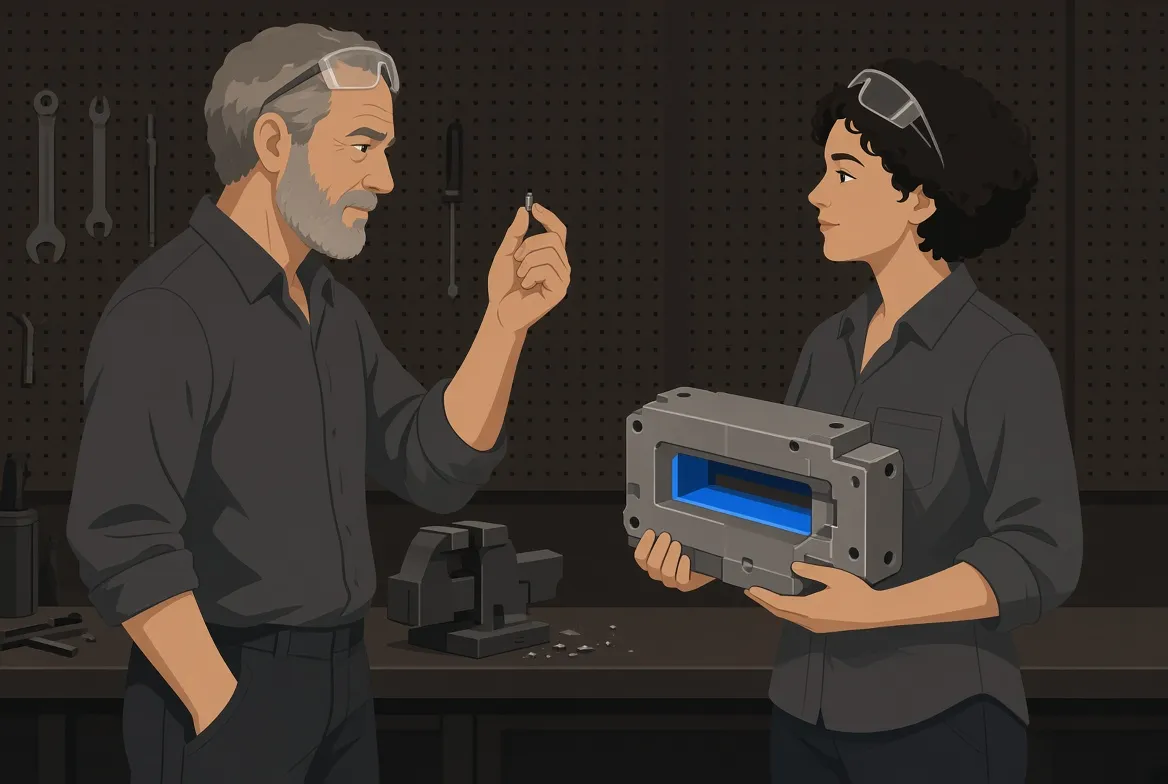
The email came in at 4:52 on a Friday last April. A semiconductor equipment builder in Arizona, nine attachments: a STEP file, three PDFs, a spreadsheet with quantity breaks at 25 and 100, and a line saying material per drawing, but they’re flexible if 15-5 is a problem.
We sent a number back the following Wednesday. Three working days plus a weekend.
Nothing about that part took three days to figure out. I’ve watched our estimator price work. Hand him the drawing, leave him alone, and he’s got a defensible number in twenty minutes. Twenty minutes of work, five days of calendar. I came into manufacturing from software, where I’d have called this a queueing problem and gone looking for the queue. There were four.
That April RFQ was ours, by the way. We were slow. Most shops are slow the same way, and it isn’t that anybody’s lazy. The process got built around email, and email doesn’t remember anything.
Where the three days went
Your RFQ lands in a shared inbox. quotes@, sales@, sometimes a salesperson’s personal address, which is worse. Shared inboxes fail the same way every time: everyone sees the message, nobody owns it. Arrive at 4:52 on a Friday and you’re competing with everybody’s drive home. Someone opens it Monday. A weekend gone before anybody clicks an attachment.
Then somebody’s got to work out what you actually asked for. Not the geometry. The request. Which revision’s current when the email says Rev C and the title block says Rev B. Whether the quantity break is 25 and 100, or 25 or 100. Whether the finish note in the email overrides the one on sheet 2. Reading comprehension, twenty to forty minutes on a messy package, done by whoever opened the email, and that’s usually not the person building the estimate.
Then the hunt for comparable work. That’s where the real time goes.
Someone remembers quoting something like this. Eighteen months ago, maybe. Different customer, 17-4 instead of 15-5, close enough to matter. Now you’ve got to find it. Ask around, dig through folders, open the ERP and guess at part numbers. Half the time the search fails and the estimate gets built from scratch, which is slower and less accurate than the number this shop already produced. We’ve priced the same geometry a year apart and come out 30% apart. Not proud of that one.
Then the estimator’s queue. We’re thirteen people. Two of us can price work, and both get pulled when a job goes sideways on second shift. The queue is short. The interrupts aren’t.
And last, the feature nobody’s cut before. A deep pocket with a corner radius that implies one specific tool. A tolerance that quietly means an extra op and a fixture. Our estimator won’t guess at those, and he shouldn’t, so it goes to a programmer or a lead machinist. That person is standing at a machine. The answer comes back when it comes back.
Add it up. One hour of thinking, spread across four people and three overnight gaps.
Nobody was thinking for three days
If quoting genuinely took three days of skilled analysis, a faster quote would be a worse quote and you’d be right to distrust anyone promising one. But the analysis was never the slow part. The slow part is finding the file, remembering the old job, getting two specific people into the same two-minute conversation, and re-reading a drawing somebody already read Monday.
The rest of the industry is saying it out loud now. Quoting is a funded software category: Uptool left stealth in February 2026 with a $6M round from Khosla Ventures, aimed at small and mid-size shops, about 98% of US manufacturing and the segment software skipped for twenty years.
The customer numbers those vendors publish are self-reported, so I’d discount them accordingly. They still point one way. An hour a quote down to fifteen minutes. Three days down under one. Nobody’s claiming the estimating got smarter. They claim the paperwork came off.
What 24 hours actually takes
We commit to 24 hours on quotes. That only means something if three things are true. They’re what I’d ask any shop about, us included.
Every RFQ becomes one record the moment it arrives. Files, revision, quantities, notes, owner, status. An email thread can’t tell you any of that, and it loses the attachment the third time it’s forwarded.
Past work has to be searchable by what the part is (geometry, material, tolerance, features), not by whether the guy who quoted it in 2024 came in today. Most of what you send us resembles something we’ve already made, and that’s only worth money if we can find it in minutes.
And the administrative reading, pulling revision, material, quantity breaks and finish callouts out of a pile of email text, PDFs and CAD, shouldn’t eat a human hour before the estimate starts. Intake and triage are automated here now. That’s where the AI lives.
Where the models run, and what that cost me
I’m the one here who says the word AI, so here’s our setup. You’d ask anyway.
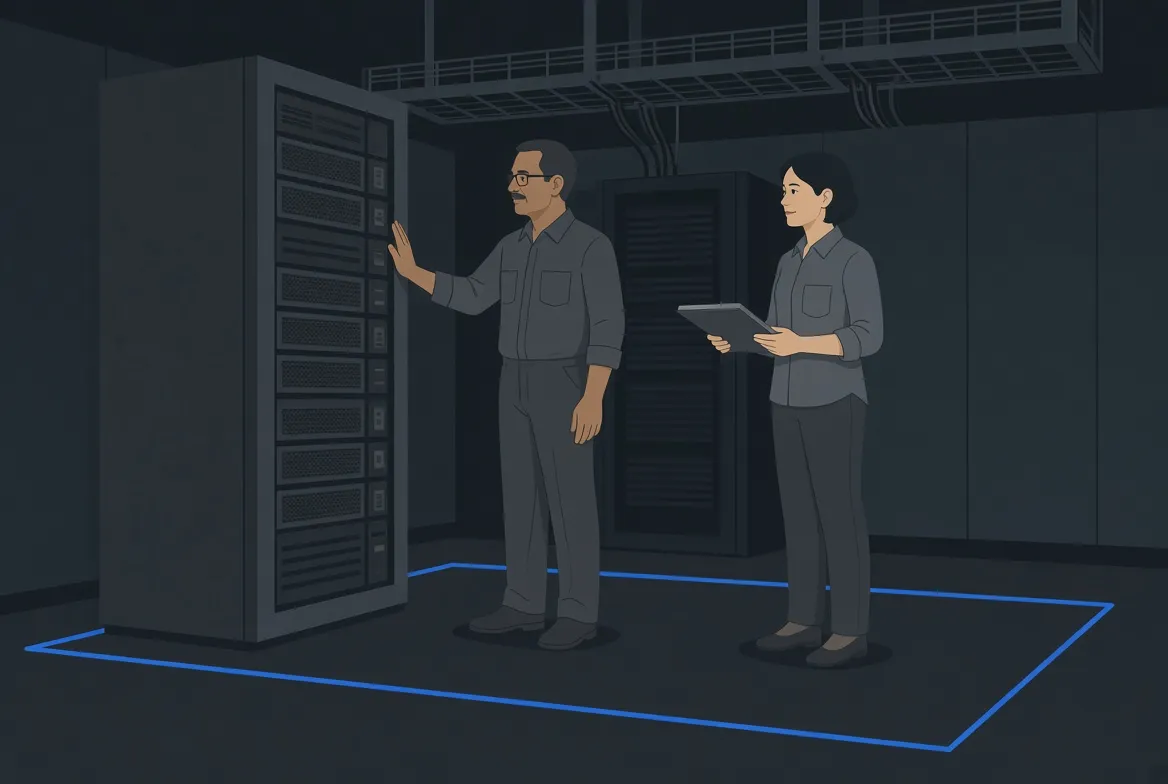
Everything runs on our own servers, in our building, on open-source models. Your files don’t go to an outside AI provider. They’re not used to train anyone’s model, ours included. That was my call, and it was the expensive one. Two used GPU boxes ran about $40,000, they sit in a closet in Stuart that used to hold shop towels, and I spent three months getting them useful. A hosted API would have been a couple hundred a month and working by Sunday night.
I did it the hard way because of a supplier audit last year, medical device customer. They didn’t ask whether our AI was accurate. They asked where the file physically sat. I didn’t love how long it took me to answer. For aerospace, medical and semiconductor work, “we send it to a third party who promises not to look” isn’t a position I want to defend.
The tradeoff is real. The open models we run are a step behind the frontier ones. For pulling structured fields out of a drawing package, that barely shows. For a couple of other things I’ve wanted to try, it shows a lot. Still the right trade.
What the software doesn’t do is price your part. It reads, organizes, and puts the closest past jobs in front of a person. A human sets the number, and a human still looks at the feature nobody’s cut. They’re just looking Monday morning instead of Wednesday afternoon.
The part I don’t have figured out
Taking the paperwork out doesn’t remove every delay. A genuinely novel part with unproven fixturing can still run past a day, and we’d rather say so on day one than go quiet until day four. A fast wrong quote costs you more than a slow one.
We quoted 214 RFQs last quarter and missed the 24-hour mark on nine. Most were the same shape: one feature nobody would commit to without an opinion from the floor.
Our founder and I have been arguing about one thing since spring and it isn’t settled. When we’re honestly unsure, do we send a number in 24 hours with the uncertainty spelled out, or hold for a better one on day three? He leans toward holding. I lean toward sending. Customers seem split, and I don’t have the data to win it yet.
The useful part for you, whoever you buy from: when a quote’s late, ask where it sat. If an engineer spent Tuesday on a tolerance stack, that’s time you want spent. If it sat in an inbox from Friday to Monday, that’s not a capability problem, and it shouldn’t show up in your lead time.